Oluwatonifemi Foundation · Case study
Making the Case for the Special Seats Bill
Through the Oluwatonifemi Foundation, we designed the graphics behind Stand To End Rape’s petition for the Special Seats Bill (HB 1349): numbers as pictures, plain answers and the people involved.
- Year
- 2025
- Scope
- Campaign graphics: data posts, explainers, a conversation graphic and a project highlight
- Tools
- Figma
01 · The campaign
One call to action, on every post
Stand To End Rape Initiative (opens in a new tab) (STER) campaigns against sexual and gender-based violence in Nigeria. Its petition for the Special Seats Bill (HB 1349), which reserves additional seats in the National Assembly for women, needed graphics that could be understood in a glance on a phone. The Oluwatonifemi Foundation (opens in a new tab), the corporate social responsibility arm of Extrafemi, designed them.
Every post ends the same way: “Sign the petition for the Special Seats Bill (HB 1349).” Everything above that line is there to make a reader care enough to sign. Several of the graphics carry the Embassy of the Federal Republic of Germany, Abuja beside the STER mark.
02 · Numbers
Numbers as pictures
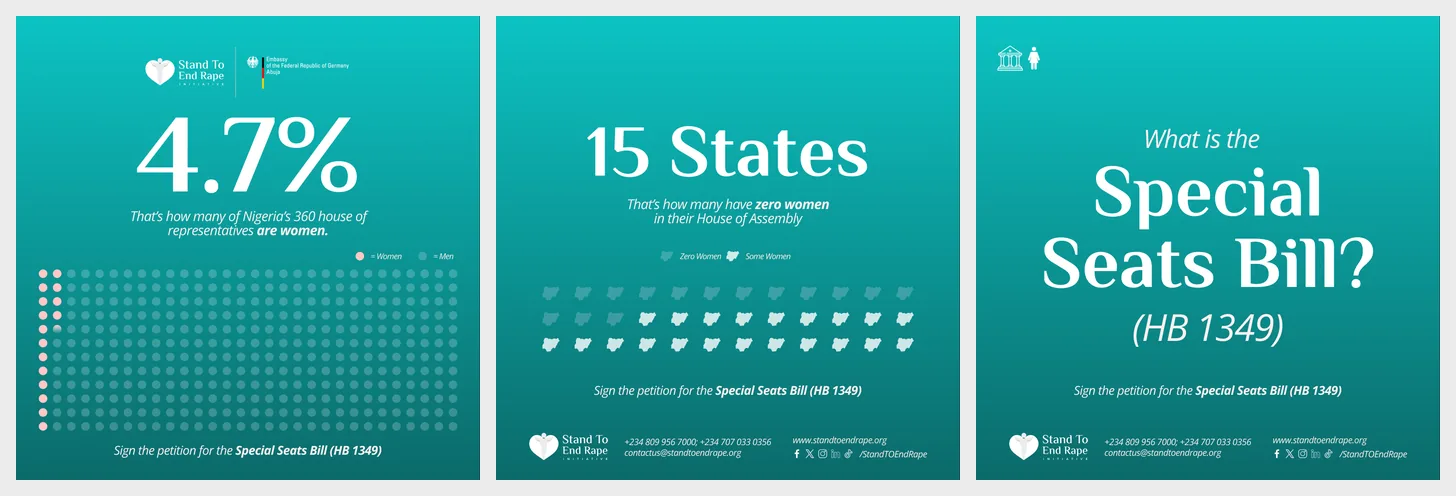
The campaign rests on three figures, and each is drawn rather than stated.
- 4.7%. That is how many of Nigeria’s 360 members of the House of Representatives are women. The post draws all 360 seats as dots, with the women picked out in pink, so the number is visible before it is read.
- 2.7%. The share of Nigeria’s 109 senators who are women, drawn the same way, so the two chambers can be compared at a glance.
- 15 states. The number of state Houses of Assembly with no women at all. A grid of state outlines shows them in a muted tone beside the states that have some.
03 · Plain answers
Plain answers to the hard questions
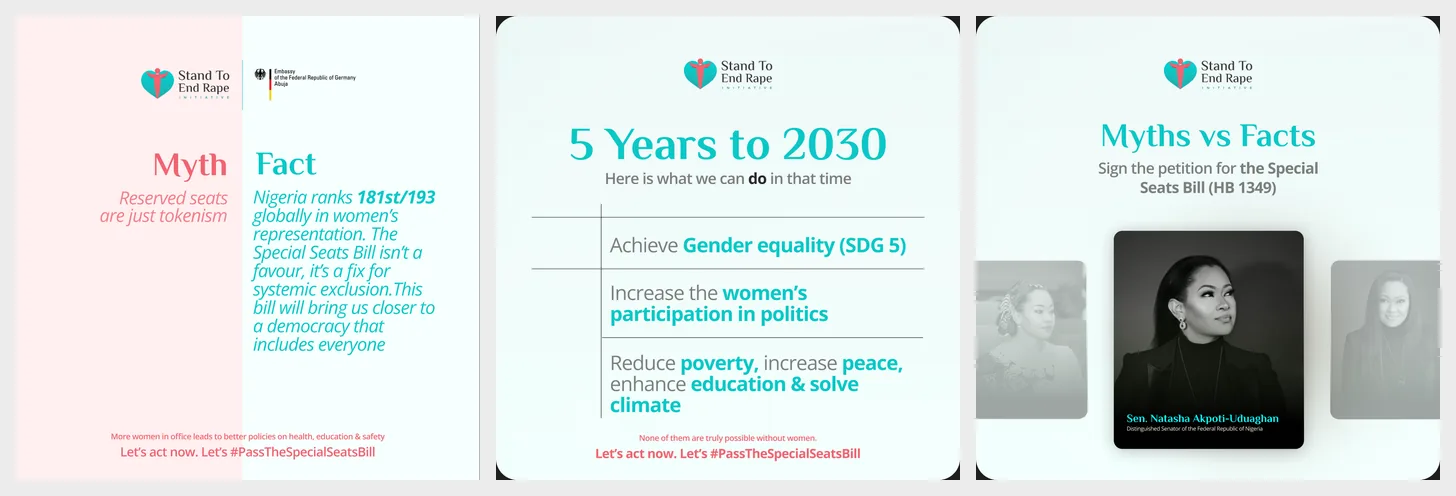
A second set of posts answers the questions people ask. One asks what the Special Seats Bill is. Another is a Myth and Fact pair. The myth, set in coral, is that reserved seats are just tokenism. The fact, set in teal beside it, is that Nigeria ranks 181st of 193 countries in women’s representation, and that the bill is not a favour but a fix for systemic exclusion.
A “5 Years to 2030” post ties the campaign to the Sustainable Development Goals: achieve gender equality (SDG 5), increase women’s participation in politics, and reduce poverty, increase peace, enhance education and solve climate. It closes on a line that carries the argument: none of them are truly possible without women.
04 · People
The people behind the numbers
The conversation graphic for Myths vs Facts puts a face to the issue: Sen. Natasha Akpoti-Uduaghan, Distinguished Senator of the Federal Republic of Nigeria, in a black-and-white portrait with her name set in teal, flanked by the other guests in softer focus.
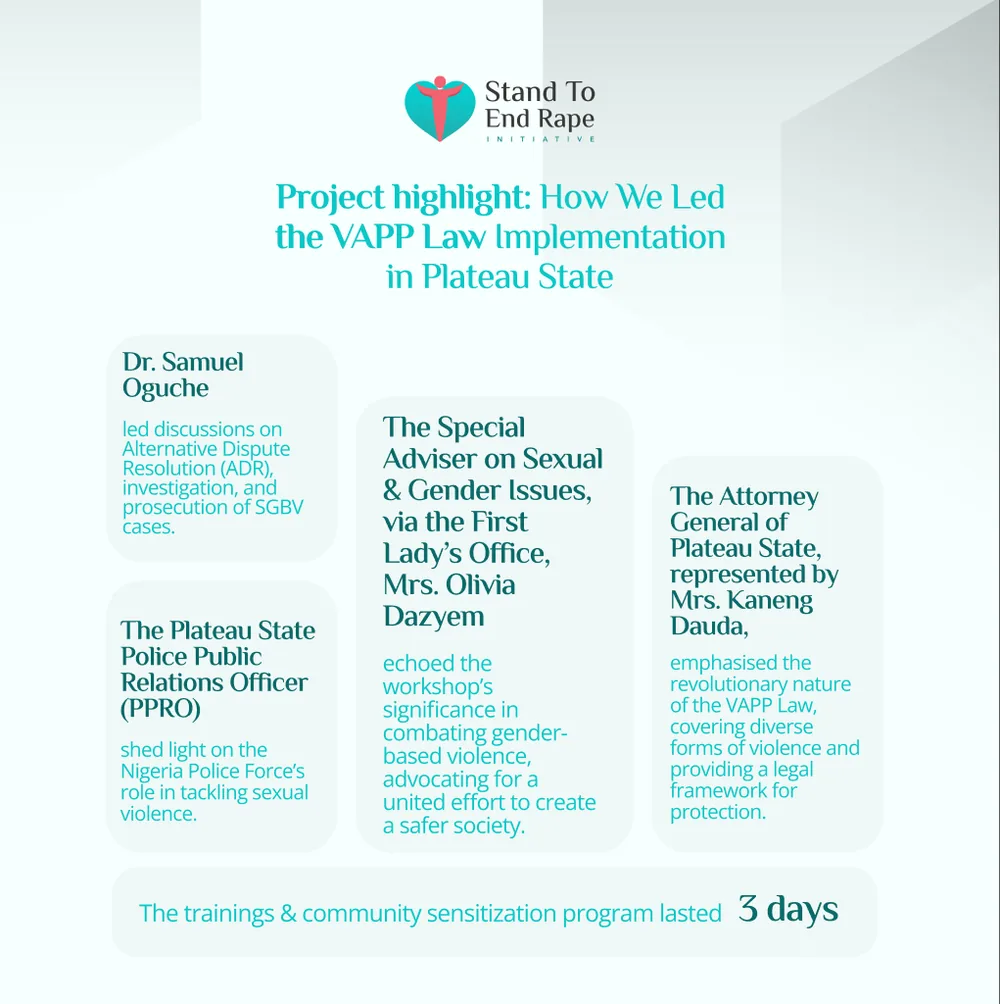
A project highlight does the same for STER’s field work, in a different register. “How We Led the VAPP Law Implementation in Plateau State” gives a card to each official and expert who took part, from a legal expert who led discussions on alternative dispute resolution to the Plateau State Police Public Relations Officer, the Special Adviser on Sexual and Gender Issues and the Attorney General, and ends on a single fact: the trainings and community sensitisation programme lasted three days.
05 · The system
One system, two moods
The campaign needed two moods and one identity. The numbers sit on a deep teal gradient with white type, so that a statistic lands like a headline. The explanations sit on a pale ground with teal and coral, so that a longer answer is easy to read. The heart-and-shield STER mark, the petition line and the contact strip stay in the same places on every post, so a reader who has seen one has seen them all.
Oluwatonifemi Foundation
Learn more about the Foundation.
The Oluwatonifemi Foundation is the corporate social responsibility arm of Extrafemi.
Visit the Foundation (opens in a new tab)